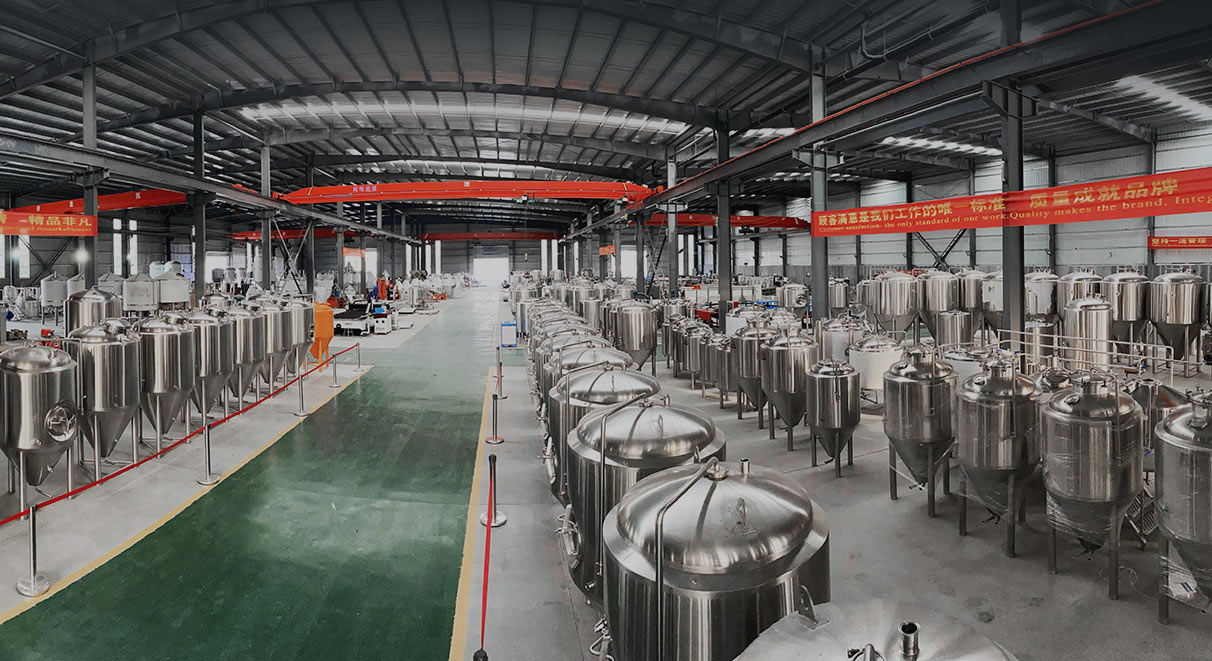
A professional turn-key brewery solution covers more than tanks and a brewhouse. It normally combines process design, malt handling, brewing, fermentation, glycol cooling, CIP, water treatment, steam or electric heating, compressed air, CO₂, sanitary piping, automation, packaging, installation, commissioning, and operator training. A 20 hL brewhouse running four brews per day can produce 80 hL of wort, so fermenter volume, refrigeration capacity, hot-water recovery, and packaging speed must support that output. If 10% of installed capacity is unavailable for cleaning or maintenance, the remaining equipment must still meet the production schedule. Turn-key supply is mainly about making every system work together at the required production rate.
The work usually starts with a production model rather than a tank list. A brewery targeting 10,000 hL per year over 250 production days needs an average finished-beer output of 40 hL per day; allowing 8% process and packaging loss raises the required upstream volume to roughly 43.5 hL. Batch size, brews per day, fermentation time, beer mix, packaging format, cleaning windows, and planned growth are then used to size the plant.
That calculation leads directly to brewhouse configuration. A two-vessel system may suit a site producing one to three batches per day, while separate mash, lauter, kettle, and whirlpool vessels allow operations to overlap. For a 20 hL batch, four brews produce 80 hL of wort; at 75% annual operating utilization, theoretical daily capacity should not be treated as guaranteed annual output.
The hot side normally includes malt milling, a grist case or conveyor, mash equipment, lautering, wort boiling, whirlpool separation, pumps, valves, instruments, hot-liquor storage, cold-liquor storage, and a plate heat exchanger. Vessel geometry, heating surface, agitation, pump curves, pipe diameter, and transfer time all affect how quickly the next batch can enter the system.
A brewhouse rated at 20 hL describes nominal batch volume, not daily beer output. Four 20 hL batches equal 80 hL before fermentation and packaging losses, while a 5% volume loss would reduce that amount to 76 hL.
Wort cooling connects hot-side production to the cellar, so heat-exchanger sizing cannot be separated from water and refrigeration design. Cooling 2,000 liters of wort from about 95°C to 18°C removes roughly 644 MJ of sensible heat before efficiency losses are considered; heat recovery can send part of that energy into brewing water rather than into a drain or cooling system.
Fermentation capacity then determines how much of the brewhouse output can actually be used. If 80 hL enters the cellar each production day and average tank residence is 18 days, theoretical occupied volume reaches 1,440 hL before allowance for headspace, cleaning, beer style variation, or scheduling. A fermenter filled to 85%-90% of gross vessel volume also needs enough free space for fermentation activity.
A cellar package therefore commonly includes cylindroconical fermenters, bright beer tanks, yeast handling equipment, pressure and vacuum protection, temperature probes, sample valves, racking ports, carbonation hardware, transfer pumps, and sanitary connections. Tank working pressure, jacket area, insulation, internal finish, weld condition, and spray-device coverage should be specified before manufacturing rather than described only by vessel capacity.
The cooling plant follows the cellar calculation. Glycol demand rises during active fermentation and rises again when tanks are crash-cooled; sizing only for steady storage temperature can leave several tanks waiting for cooling. A practical engineering model includes simultaneous fermentation, crash cooling, bright-tank cooling, ambient conditions, pump head, glycol concentration, and a reserve margin such as 10%-15% where expansion is planned.
| System | Design input | Example sizing question |
|---|---|---|
| Brewhouse | Batch volume and brews/day | Can 4 × 20 hL batches be completed inside the production shift? |
| Fermentation | Fill volume and residence time | How many tanks are occupied during an 18-day cycle? |
| Glycol | Simultaneous heat demand | Can several tanks cool without losing temperature control? |
| Packaging | Finished beer/day | Can 76 hL be packed before the next bright-tank transfer? |
| CIP | Tank and pipe volume | Can cleaning fit inside the available production window? |
Cleaning becomes the next engineering link because the same tanks, pipes, hoses, valves, and heat exchangers repeatedly contact wort or beer. Brewery CIP commonly uses controlled combinations of chemical concentration, temperature, circulation time, and mechanical flow; a process using a 2% alkaline solution is very different from one specified only as “caustic cleaning” because pump rate, return temperature, soil level, and contact time also affect the result.
A professional system may use a mobile CIP cart for a small plant or a multi-vessel station with separate caustic, acid, rinse-water, recovery, dosing, and heating functions. If a tank cleaning cycle occupies 45 minutes and six tanks require cleaning in one day, 4.5 hours of CIP pump availability is already committed before brewhouse or packaging cleaning is counted.
CIP design then affects water demand. Brewing water, rinse water, boiler-feed water, packaging water, and general service water do not always require the same treatment. Carbon filtration, softening, reverse osmosis, UV treatment, mineral adjustment, storage, and distribution may be combined according to incoming-water analysis, while a 10% change in source-water mineral concentration can matter to process consistency even when total water volume stays unchanged.
Thermal utilities must be calculated beside the water system. Steam-heated breweries can require a boiler, feed-water treatment, steam headers, pressure reduction, traps, condensate return, valves, insulation, and safety devices; electric brewhouses instead place more demand on the electrical service. A 120 kW electric heating package operating at 90% simultaneous demand represents about 108 kW before pumps, refrigeration, compressors, packaging equipment, and building services are added.
Compressed air and process gases form another connected utility group. Pneumatic valves need dry, regulated air, while CO₂ is used for tank purging, transfers, carbonation, and packaging; nitrogen may be specified for selected processes. Gas distribution therefore needs regulators, manifolds, isolation points, pressure control, suitable piping, and consumption calculations tied to actual packaging and cellar schedules.
Piping connects all of the equipment physically. Product lines should be sized for the intended flow rate and cleaning velocity, with sanitary fittings, drainable routing, limited dead legs, and access for inspection or maintenance. Increasing pipe diameter from 38 mm to 51 mm increases internal cross-sectional area by roughly 80%, so a larger pipe can require substantially more liquid to reach the same linear cleaning velocity.
For projects combining several beverage processes, a Brewery/Distillery/Winery All-In-One Solution can place shared utilities, water treatment, cooling, storage, control architecture, and selected cleaning equipment under one engineering scope. Shared equipment still needs separate operating calculations because brewing, distillation, and wine production can have different temperature, material, sanitation, and process-flow requirements.
Automation sits on top of the mechanical design rather than replacing it. A PLC and HMI may control pumps, temperatures, levels, steam valves, transfer sequences, CIP steps, alarms, recipes, and interlocks, but the control system cannot correct an undersized heat exchanger or poorly routed pipe. A temperature sensor with ±0.2°C accuracy is useful only when its location represents the product being controlled.
Automation level should therefore match staffing and production frequency. A brewery running one batch every few days may accept more manual valve operation, while a plant producing four or six batches per day can benefit from recipe steps, valve position feedback, flow measurement, trend recording, and automated transfer sequences. Even 5 minutes removed from six repeated transfers saves 30 operator-minutes per production day.
Packaging must be checked against the same production model. Keg washing and filling, canning, bottling, labeling, date coding, conveyors, carton handling, and pallet preparation can all be included in the turn-key scope. If 7,600 liters must be packaged during an eight-hour shift, the line needs to average at least 950 liters per hour before planned stops, changeovers, cleaning, and reject rates are included.
A packaging line running at 90% mechanical availability would need a higher rated speed than the average requirement. Container format also changes the calculation: 7,600 liters equals about 22,727 cans at 330 mL or 15,200 cans at 500 mL, so filler speed, seamer capacity, label application, coding, accumulation, and secondary packaging should be evaluated as one line rather than as separate machine specifications.
Facility layout is prepared around those flows. Engineers need tank dimensions, ceiling height, floor loading, drainage, door openings, crane access, operator clearance, pipe corridors, utility rooms, chemical storage, packaging movement, and maintenance space. A fermenter that physically fits beneath a ceiling can still be impractical if only 3% clearance remains for fittings, lifting, insulation work, or future servicing.
Manufacturing follows the approved layout and process documents. The supply package may include material certificates, vessel drawings, piping and instrumentation diagrams, electrical drawings, control descriptions, pressure-test records, weld inspection, surface-finish requirements, component lists, manuals, and spare-parts schedules. Acceptance criteria should be written before shipment, including capacity, working pressure, electrical standard, instrumentation, control functions, and agreed factory tests.
Installation then joins equipment supply with the building. Positioning vessels, leveling frames, connecting product pipework, installing glycol and utility lines, terminating electrical cables, checking controls, insulating pipes, and testing drainage may be supplier work, local-contractor work, or a divided responsibility. A contract leaving even 10% of these interfaces undefined can create expensive work that neither party priced.
Commissioning tests the plant as one production system. Pumps should be checked for rotation and flow, valves for correct position, instruments for calibration, tanks for temperature response, heating systems for performance, refrigeration for pull-down capacity, CIP for return flow, and automated sequences for interlocks. Water trials can verify transfers and cleaning before beer enters the system and before product loss becomes part of troubleshooting.
The final commercial scope should state who supplies freight, unloading, cranes, boiler work, refrigeration, electrical service, drainage, ventilation, water treatment, laboratory equipment, packaging, local permits, commissioning, training, spare parts, and post-installation support. In a market where U.S. craft brewery counts exceeded 9,000 by 2024, equipment selection alone is no longer enough; production economics depend on how many saleable liters the installed plant can make, cool, clean, transfer, package, and repeat within the scheduled hours.