Stopping Repetition in Long Adult AI Chats
Repetition in a long adult AI chat rarely arrives suddenly; it builds out of a thread that has stopped receiving new information. The symptom is easy to spot — the same phrasing, the same rhythm, the same opening move in reply after reply — and the cause is usually the input rather than the service. Fixing it is mostly a question of what you send next.
Key takeaways
- Repetition tracks the input, not the clock: a thread with no new detail has nothing new to reflect.
- A 30-minute session that stalls after minute 22 wastes 8 minutes — about 128 minutes a month across 16 sessions.
- Starting a fresh thread is a legitimate fix, not an admission of failure.
- Naming what you want works better than listing what you do not, because a negative gives the reply nothing to aim at.
Diagnosing the loop before changing anything
The first task is to separate three different problems that all look like repetition. The first is a genuine loop, where consecutive replies echo each other because your own messages have echoed. The second is drift, where the conversation has moved somewhere you did not intend and keeps confirming your last message as the new normal. The third is premise exhaustion, where the scenario has run out of places to go and every reply is the scenario restating itself.
You can tell them apart by reading your own last four messages. If they are variations of one sentence, it is a loop. If they contain a detail you did not choose, it is drift. If they are just short continuations with no new element, the premise is exhausted. The distinction matters because each one has a different fix, and applying the wrong one wastes a session. Everything outside your own messages on a Porn Chat AI platform — the card you picked, the context already retained, the broad tone of the service — was fixed before you began typing, so the input is the only lever available mid-thread.
Fixes that work inside the same thread
For a loop, change the shape of your input rather than its content. A one-line message followed by a longer, more specific one breaks a rhythm that two similar messages will not. For drift, restate the premise in a single clear sentence and let the next reply re-anchor around it; two sentences usually over-correct and reset the whole scene. For premise exhaustion, the thread has done its job and there is little value in pushing it further.
Content removal policy and community guidelines still apply to whatever you send, so the fixes here are about direction rather than licence. Crushon describes its service as unfiltered and its FAQ notes that some limitations apply under those guidelines, which is worth remembering when a reply declines something: that is a boundary, not a malfunction, and the useful move is to redirect rather than to repeat the request in different words.
When to abandon a thread and start clean
A fresh thread costs almost nothing and returns the whole premise to a clean state, which is why it is the most reliable fix available. Characters recall previous interactions, so a new thread with the same character is not amnesia — it is the same relationship approached from a different point. Where the drift was caused by a single line you regret, a fresh thread is far cheaper than ten messages spent steering back.
The trade-off is continuity. Long threads carry accumulated context, and that is precisely what makes them feel developed. The practical rule is to start fresh when the scenario has changed shape, and to stay when only the moment has changed. Readers who never start fresh tend to describe repetition as a platform problem; readers who start fresh too often never get the accumulated context that makes long threads worthwhile.
| Symptom | What it usually means | Cheapest fix |
|---|---|---|
| Echoed phrasing | Your last messages are variations of one line | Change message shape: short, then specific |
| Scene moved away | The premise drifted and is confirming itself | Restate the premise in one sentence |
| Flat continuations | Scenario exhausted, no new element to add | Start a fresh thread with the same character |
| Repeated refusal | A request sits outside the content and community guidelines | Redirect instead of rephrasing the same request |
| Stall inside a session | Long sessions without setup time | Two minutes of framing saves the 8 minutes after minute 22 |
Worked example: the arithmetic of a stalled half hour
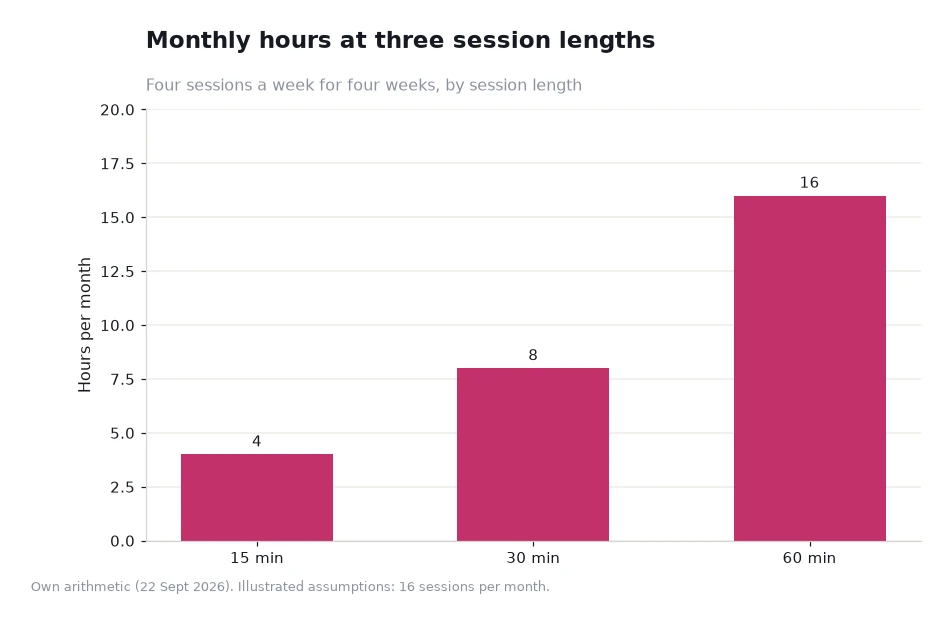
Illustrative assumption: 16 sessions a month at 30 minutes each, which is 480 minutes, or 8 hours. Suppose the thread typically stalls around minute 22 of each session, leaving 8 minutes in which the conversation repeats itself. Sixteen sessions × 8 minutes is 128 minutes a month, which is 128 ÷ 60 ≈ 2.1 hours of the 8-hour total — roughly a quarter of all platform time spent watching a loop.
Two minutes of setup at the start of each session costs 32 minutes a month and is aimed directly at that 128-minute loss. The recovery is never certain, but the trade is easy to state: 32 minutes spent framing beats 128 minutes spent repeating. If sessions are longer, the ratio gets worse rather than better — the same 16 sessions at 60 minutes each is 16 hours a month, and a stall at a comparable point wastes twice as much.
Reading repetition in an ai porn chat thread
Treat repetition as feedback about the thread rather than a verdict on the technology. The characters on Crushon are described as recalling earlier interactions and adapting over time, which means a long thread contains a memory of everything you have already said. When that memory is full of near-identical messages, the replies it produces will be near-identical too, and the correction has to come from you.
A five-line reset is usually enough: one line restating who and where, one line naming what you want to happen next, and a decision to either continue or start fresh. Five lines takes under a minute, and it converts a stalled session into a usable one. The character search page is worth a visit if the same character stalls repeatedly with the same premise, because a different premise with a familiar character often produces a better thread than a new character with the same old opening.
Frequently asked questions
Why do replies repeat themselves after a long chat?
Because a long thread that receives no new detail has nothing new to work from. When your own messages converge on one shape, the replies converge too, and the echo is a reflection of the input rather than a fault in the service.
Is starting a new chat the right fix?
It is the most reliable fix when the scenario has changed shape, and it is cheap because characters recall earlier interactions. Use it when the premise moved; stay in the thread when only the moment changed.
How much time does a stalled session actually waste?
On the illustrative 30-minute session that stalls around minute 22, 8 minutes. Repeated across 16 sessions a month that is 128 minutes, about 2.1 hours, out of an 8-hour month.
Fix the input, not the platform
Read your own last four messages first, decide whether you are looking at an echo, a drift or an exhausted premise, and apply the smallest fix that answers it. Two minutes of framing at the start and a willingness to start fresh when the scene really has changed will recover more of a month than any amount of rephrasing inside a stalled thread.
Data and sources: the Crushon porn chat page for the platform's descriptions of recall and adaptation and for the note that some limitations apply under its content and community guidelines[1], plus the search page for tag browsing[2], read 22 Sept 2026. Session lengths, stall points and monthly-hour totals are illustrative assumptions. Intended for readers who are adults of 18 or older.